
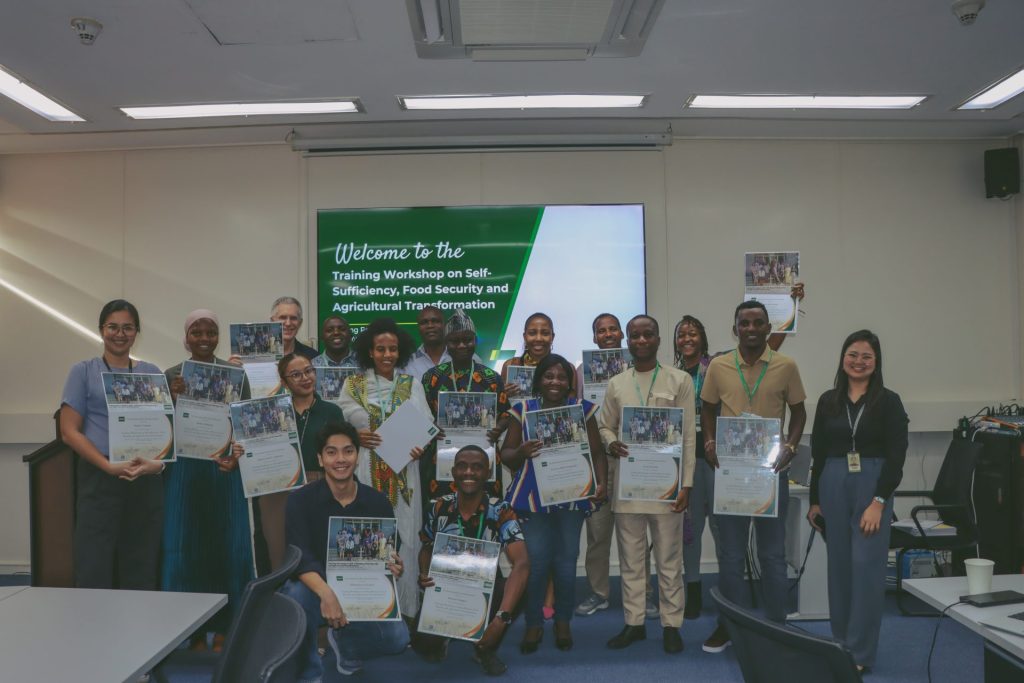
Photo Credit: IRRI Education
Ten researchers and agricultural professionals from seven African countries participated in a training workshop examining the connections between food self-sufficiency, food security, agricultural transformation and trade policy.
The four-day workshop, held from 6–9 July 2026 at the International Rice Research Institute (IRRI) headquarters in Los Baños, Philippines, brought together 15 participants from Africa and Asia.
Through the CGIAR Capacity Sharing Accelerator (CapSha), five women and five men from Ethiopia, Ghana, Kenya, Rwanda, South Africa, Tanzania and Zimbabwe were supported to participate.
The workshop was delivered by IRRI Education as part of a collaboration with CapSha’s Area of Work 3, which works with CGIAR centers and national partners to expand access to relevant capacity-sharing opportunities.
Examining difficult policy choices
Countries often pursue both food security and greater food self-sufficiency, but the two objectives are not always the same.
Food security concerns whether people have reliable access to sufficient, safe, and nutritious food. Food self-sufficiency focuses more narrowly on how much of a country’s food demand is met through domestic production.
Policies intended to increase domestic production can therefore involve difficult choices concerning food prices, imports, agricultural investment, nutrition, and the livelihoods of producers and consumers.
The workshop helped participants examine these relationships and consider how agricultural and food-trade policies influence poverty reduction, nutrition, and national development.
Sessions covered agrifood systems transformation, agricultural policy, international food trade and the changing role of agriculture in economic development. The programme combined lectures from agricultural economists and food-policy specialists with discussions, group exercises, and country presentations.
Participants were encouraged to apply the concepts to their own national contexts, compare experiences, and consider how different policy choices might affect food availability, affordability, and nutrition.
One participant described the workshop as a valuable opportunity for “knowledge exchange from various participants sharing the information and status of their country.”
Another said the training helped them connect indicators such as agricultural production, employment, agriculture’s contribution to gross domestic product, food self-sufficiency, diet affordability and nutrition outcomes.
The workshop also challenged participants to consider agricultural research within a wider policy and development system.
Participants also visited IRRI research facilities, including its Grain Quality and Nutrition Laboratory, Plant Growth Facility, Speed Breeding Facility and International Genebank. These visits demonstrated how agricultural research, crop improvement, and conservation contribute to broader food-security objectives.
Expanding access through collaboration
The training was one of three IRRI Education programmes for which CapSha supported the participation of African researchers and professionals in 2026.
Potential participants were identified through CGIAR and African research networks.
By working through existing training programmes and partner networks, CapSha aims to connect researchers and institutions with learning opportunities that respond to identified capacity needs.
The collaboration also created opportunities for participants from different countries and professional backgrounds to learn from one another, build relationships, and examine shared food-system challenges from multiple perspectives.
This work is carried out with support from the CGIAR Capacity Sharing Accelerator (CapSha). We would like to thank all funders who supported this research through their contributions to the CGIAR Trust Fund: https://www.cgiar.org/funders/