
By: Angelica Barlis, Alliance of Bioversity & CIAT
South–South cooperation is often described as an exchange of knowledge, technology and expertise. But lasting cooperation depends on what happens after that exchange: whether institutions can adapt what they receive, build on it and eventually share capacity of their own.
Across the Global South, countries and institutions have developed deep expertise in tackling challenges such as soil degradation, climate pressures, crop productivity and food security. These make a good case for cooperation, but what makes it work in the real world, long after the project has ended?
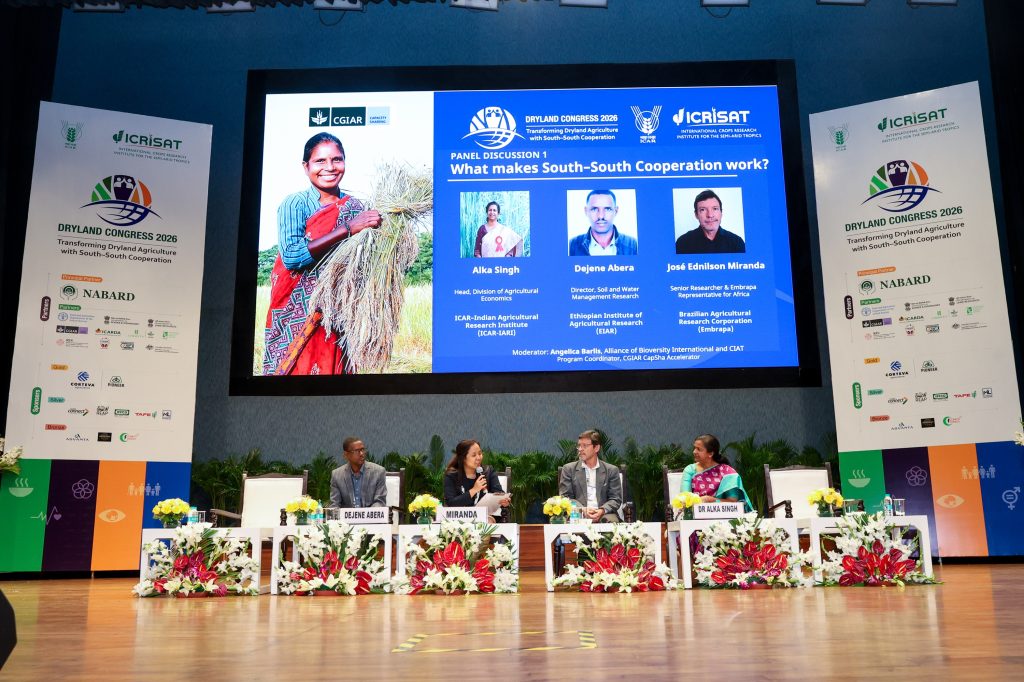
I explored these questions during a panel marking the UN Day for South-South Cooperation with Dr. José Ednilson Miranda of the Brazilian Agricultural Research Corporation (Embrapa), Dr. Alka Singh of the Indian Council of Agricultural Research-Indian Agricultural Research Institute (ICAR-IARI), and Dr. Dejene Abera of the Ethiopian Institute of Agricultural Research (EIAR). The panel held at the 2026 Dryland Congress hosted by ICRISAT.
Instead of concentrating only on success stories, I also asked about where cooperation had fallen short and what institutions need to make partnerships more reciprocal and sustainable.
Adaptation matters as much as transfer
Dr. Miranda described Embrapa’s Cotton 4 initiative with Mali, Benin, Chad and Burkina Faso. Because Brazil and the participating African countries share tropical growing conditions, Brazil’s experience in cotton production offered a useful starting point.
But the partnership was not simply about transferring Brazilian technologies. Cotton production was integrated with staple crops, bio-inputs were introduced, and local laboratory capacity was strengthened. In one example, agricultural tools provided to women farmers were modified because the original design did not suit the way some women worked while carrying babies on their backs.
The example shows why technical suitability alone is not enough. Local knowledge therefore has to be part of the innovation process, not something considered after a solution has already been designed. It also changes the relationship between partners: rather than one institution arriving with a predefined solution, both sides decide what can be adopted, what needs to change and what may not be suitable at all.
Build institutions, not only individual skills
Dr Abera’s experience in Ethiopia showed what can happen when capacity becomes embedded within institutions.
Through EIAR’s collaboration with CGIAR on digital, site-specific fertilizer advisory services, the work began with co-design and co-implementation, with the national research system playing a leading role. Capacity sharing later extended to regional research institutes.
Over time, Ethiopia developed enough capability not only to apply the approach domestically, but also to provide technical support to a research institution in Rwanda.
That progression from receiving expertise, to adapting it, to sharing it elsewhere, is a useful measure of whether capacity has really taken root.
Dr Singh made a similar point about measurement. Numbers of people trained, workshops held or webinars delivered demonstrate activity, but they do not necessarily show lasting change.
We need to probe whether people are applying new capabilities within national research systems and whether cooperation is producing tangible results, such as joint varietal releases. Employees switch jobs and projects end. If capacity is expected to last, knowledge, systems and relationships need to become part of the institution itself.
Cooperation also needs the right conditions
Technical expertise alone is not enough.
Dr Abera described one collaboration in which geopolitical circumstances disrupted the flow of resources to EIAR, delaying planned activities until seed funding provided another way forward.
Dr Singh emphasized another part of the same problem about cooperation depending on policies, institutional arrangements and the socioeconomic context in which technologies will be used. A technology crossing a border does not mean it will automatically be adopted, much less scaled.
Dr Miranda also challenged the idea that South–South cooperation is mainly about one country providing expertise to another. Brazil benefits too, he said, through opportunities to co-develop technologies, learn from partners and address shared challenges.
That shifts the consideration from what one institution can provide to what partners can learn and solve together.
What does this mean for CapSha?
I ended by asking what gap the CGIAR Capacity Sharing Accelerator could realistically help fill.
Dr. Singh encouraged the accelerator to focus on problems shared across geographies, where institutions can bring complementary expertise. Dr. Abera emphasized that capacity sharing should be continuous, demand-driven and embedded at different levels of an institution.
Dr. Miranda suggested mapping capacity demand and supply, connecting institutions and creating mechanisms through which they can exchange lessons from practice. He also cautioned against top-down models that overlook local knowledge.
These perspectives point to a clear role for the Capacity Sharing Accelerator. CapSha does not need to become another provider delivering capacity development to institutions. It can help institutions find one another, identify shared problems and build relationships through which capacities can flow in more than one direction.
If there’s one takeaway I am eager to leave you with, it is that cooperation is more likely to last when institutions shape the work themselves and can adapt knowledge to their own context. The capacity built through the partnership also needs to remain after the project ends, rather than disappearing with it.
This work is carried out with support from the CGIAR Capacity Sharing Accelerator. We would like to thank all funders who supported this research through their contributions to the CGIAR Trust Fund: https://www.cgiar.org/funders/