
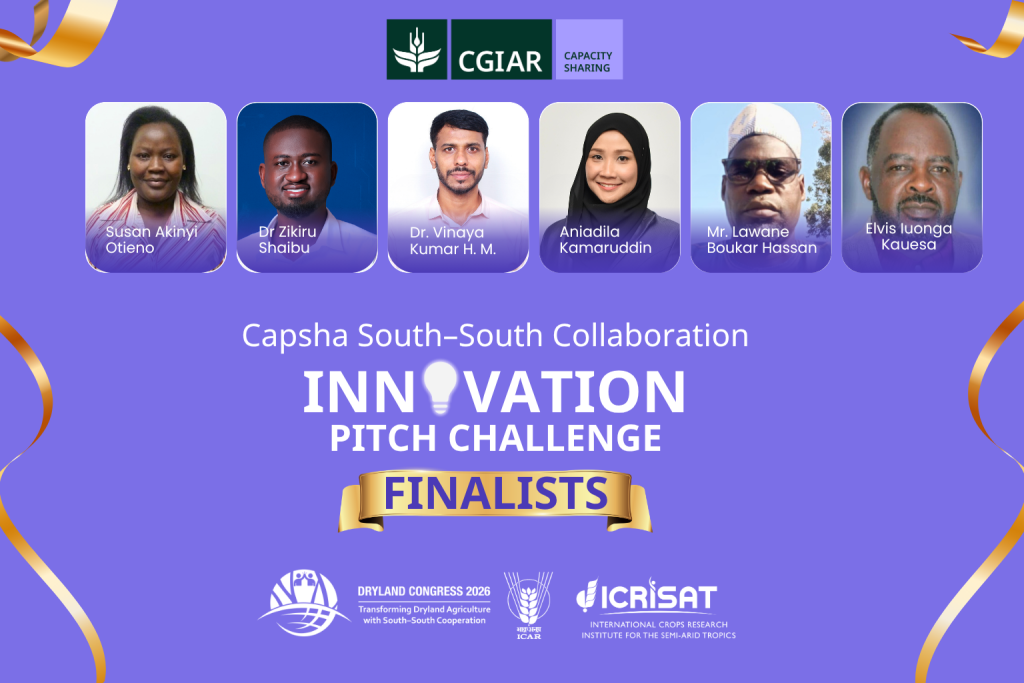
Six finalists have been selected to present their ideas at the CapSha South-South Collaboration Innovation Pitch Challenge, taking place during the International Dryland Conference, from 10-12 September, 2026.
The Challenge was launched by the CGIAR Capacity Sharing Accelerator (CapSha) to identify demand-driven approaches that can strengthen collaboration between CGIAR and National Agricultural Research, Extension and Education Systems (NAREES). It reflects CapSha’s emphasis on moving beyond conventional training models towards co-creation, mutual learning, equitable partnerships and longer-term institutional capacity sharing.
The six finalists bring proposals from Africa and Asia spanning climate-resilient agriculture, digital tools, carbon farming, institutional collaboration and community-led innovation.
Meet the finalists
Dr Zikiru Shaibu, University of Cape Coast, Ghana
Dr Zikiru Shaibu is a lecturer and researcher in agricultural economics and extension whose work combines UAV multispectral sensing, machine learning and agricultural extension. His proposal, developed in partnership with the Université d’Abomey-Calavi, seeks to establish an open, bilingual UAV phenotyping standard that West African NAREES institutions can jointly own, use and extend. The approach treats technical protocols as shared research infrastructure rather than knowledge transferred through one-off training.
Dr Vinaya Kumar Hebsale Mallappa, Keladi Shivappa Nayaka University of Agricultural and Horticultural Sciences, India
Dr Vinaya Kumar H. M. is an Assistant Professor whose work covers climate-smart agriculture, carbon farming, digital agriculture and institutional capacity development. He will present the Carbon Knowledge Co-Creation Framework (CKCF), an institutional process designed to bring together CGIAR, NAREES, researchers, educators, extension professionals, farmers, policymakers and market actors to jointly develop, validate and update knowledge on carbon farming and agricultural carbon credits.
Mr Lawane Boukar Hassan, Ministry of Agriculture and Rural Development, Cameroon
An agricultural engineer and agronomist, Mr Lawane Boukar Hassan manages agricultural input quality control in Cameroon’s Adamaoua Region, including seed certification and compliance. His proposal focuses on building capacity for climate-resilient potato seed production, adapting Indian soil-management approaches to address phosphorus constraints in Adamaoua’s acidic clay soils. The initiative is intended to support peer learning and institutional collaboration around practical South-South solutions for potato production.
Dr Susan Akinyi Otieno, KALRO Horticulture Research Institute–Tigoni, Kenya
Dr Susan Akinyi Otieno is a potato breeder and Centre Director with more than 15 years of research experience across plant breeding, genetics, biotechnology, disease resistance and seed potato systems. Her proposal, “Towards AfricaBlight: A Kenya-led South–South Pilot for Collaborative Potato Late Blight Decision Support,” applies digital and climate-smart approaches to potato disease management while strengthening peer learning and institutional partnerships in Africa.
Aniadila Kamaruddin, Malaysian Agricultural Research and Development Institute, Malaysia
Aniadila Kamaruddin is a Research Officer at MARDI, where her work focuses on international networking, institutional collaboration and knowledge exchange. She will present a Regional Capacity Sharing Model for South–South Agricultural Innovation across Asia and the Pacific, designed to create a structured mechanism through which institutions can both contribute and access expertise, infrastructure and practical solutions across borders.
Sir Elvis Iuonga Kauesa, University of Namibia, Namibia
Sir Elvis Iuonga Kauesa is a community development practitioner and legal advisory lead representing the University of Namibia in partnership with the African Wild Dog Conservancy and Maharero Traditional Authority. His proposal advances Community-Led Innovation Labs, intended to embed climate-smart and nutrition-sensitive practices within NAREES institutions while strengthening links between research institutions and indigenous communities.
Pitching on the big stage
At the conference, the finalists will present their proposals and make the case for how their approaches can strengthen institutional capacity, improve knowledge exchange and support more durable partnerships. These are central considerations in the Challenge, alongside scalability, sustainability and the potential for CGIAR and NAREES to achieve greater impact through collaboration.
The pitch session will also provide an opportunity for the finalists to receive feedback, exchange experience and connect with institutions working on similar challenges across regions.
This work was supported by CGIAR Capacity Sharing Accelerator. We would like to thank all funders who supported this research through their contributions to the CGIAR Trust Fund (https://www.cgiar.org/funders/).